A Backbeat Is Not a Whole Groove
Learn to hear a Southern music groove beyond its backbeat by following bass, subdivisions, accents, and the spaces that shape its feel.
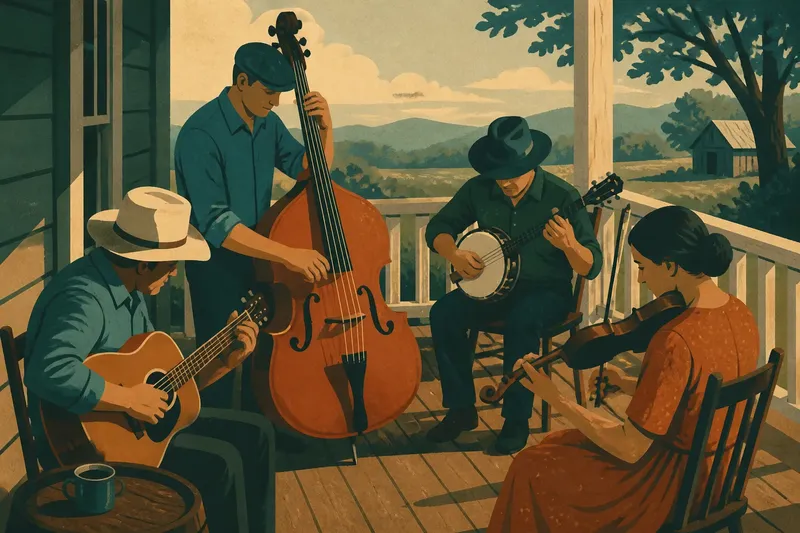
A Southern music groove can feel loose, driving, or buoyant even when the snare accents stay in the same places. To hear why, listen beyond the backbeat: follow the bass, the smaller notes between beats, and the spaces the players leave open.
Hear the layers
In much country, blues, and roots music, a backbeat often falls on the second and fourth beats of a measure. That description is useful, but two songs with the same backbeat can feel entirely different: one may lope, another may drive, and a third may seem to hover.
Try listening to a recording through different layers. First follow the kick drum or low bass notes. Then track the snare or handclaps, and finally listen for the guitar, piano, banjo, or fiddle filling the spaces between them. You are not hunting for a hidden “correct” rhythm; you are noticing how the parts interact.
A drummer’s ride cymbal or a guitarist’s repeated strum can keep time without making the backbeat louder. In a small acoustic group, the same pulse may come from bass notes and a steady guitar pattern, with no drum kit at all. The role matters more than the instrument: one part marks weight, another keeps the motion moving.
Notice the subdivisions
The beat is only the broad frame. Between its main pulses, a musician may play even subdivisions, a swung pair of notes, a shuffle, or a loose pattern that nudges ahead and falls back. Those small choices give a groove much of its character.
In a shuffle, the subdivision has a loping, long-short feel rather than two evenly spaced notes. A straight pattern divides the space more evenly, though players can still vary their touch and timing. A bluegrass band may create urgency through quick, continuous picking; a country song may leave more air between a bass note and a guitar strum.
Listen for how the smaller notes sit against the main beat. Are they clipped and bright, brushed softly, or pushed forward? A mandolin chop can add a crisp accent, while a banjo roll threads a stream of notes through the measure. Neither sound is simply “the backbeat”; each changes how the pulse feels.
Follow the bass
The bass line often reveals the groove’s direction. It may land firmly on the main beats, alternate between a low root and a higher chord tone, or move through notes that lead into the next chord. A repeated bass pattern can make a song feel grounded even when the upper instruments are busy.
Notice whether the bass and kick drum strike together or answer one another. When they lock together, the pulse can feel solid and square. When the bass moves between the drum accents, the groove may seem to roll or lean forward. These are listening descriptions, not strict rules; musicians shape them differently from song to song.
Say you hear a country band with a clear snare on two and four. Imagine the bass playing a steady low note on each beat while the acoustic guitar strums between them. The expected result is a more buoyant feel than if the bass held longer notes and the guitar played broad, sustained chords, even though the snare accents stayed in the same places.
Listen for pocket?
“In the pocket” describes a shared sense of timing that feels settled and coordinated. The players need not strike every note at precisely the same instant; their small differences can help the music breathe. A groove can have no drums, too: bass, guitar, banjo, piano, or handclaps may establish the pulse and reinforce accents.
What does “in the pocket” mean?
It describes a shared sense of timing that feels settled and coordinated. The players need not strike every note at precisely the same instant; their small differences can help the music breathe.
Can a groove have no drums?
Yes. A bass, guitar, banjo, piano, or handclaps can establish a pulse and reinforce accents without a drum kit. Listen for which part carries the low weight and which parts mark or fill the smaller divisions.
What is the difference between swing and shuffle?
Both can use uneven subdivisions, but “shuffle” often points to a more clearly repeating long-short pattern. “Swing” can describe a broader rhythmic feel, with the degree of looseness and lilt shaped by the performers.
Why does the same backbeat feel different in two songs?
The surrounding parts may differ in subdivision, bass movement, accent strength, and note length. A snare accent gives only one clue; the interaction of all those details makes the groove distinctive.
Make room for silence
What a musician leaves out can matter as much as a played note. A guitar that strums on every beat creates a different surface from one that strikes a chord, then leaves a gap. That pause gives the next bass note or vocal phrase somewhere to land.
Watch for short rests at the end of a sung line, a held chord that lets the drums carry the motion, or a stop in the full band before the next phrase. Such gaps are not breaks from the groove; they shape its tension and release. In a dance setting, a little space can also make the next accent feel more distinct.
Track the changes
A groove can shift without changing its basic backbeat. A drummer may move from a closed hi-hat to a ride cymbal, a guitarist may switch from short chops to fuller strums, or the bass may become more active as a verse gives way to a chorus. Listen for changes in texture as well as changes in the main accents.
For a focused pass, choose one instrument and follow it through a whole verse. On the next pass, choose another. A streaming app’s repeat control can help, but a live performance works just as well: watch the bassist’s hands, then shift your attention to the drummer or the player keeping time with a foot tap.
When someone says a song has a “strong backbeat,” treat that as a starting point. Ask what the bass does, how the subdivisions move, where the accents soften, and which silences make room for the next phrase. That is how a simple label opens into a more precise, rewarding account of the groove you are hearing.